How to Choose a GHK-Cu Supplier: Purity, COAs and Shipping
A supplier's COA is only useful if it matches your exact batch. When the paperwork is generic or the purity claim stops at a label, your research starts on uncertain ground, and no protocol can fix a reagent you cannot trace.
This article breaks down how to judge a GHK-Cu supplier on three concrete points: purity verified by HPLC, per-batch COAs retrievable by batch number, and shipping that reaches U.S. and Canadian labs intact. By the end, you will know how to compare options and decide whether Kovagen fits your lab's requirements.
What Is Kovagen (KOVA)? A Research Peptide Supplier Defined
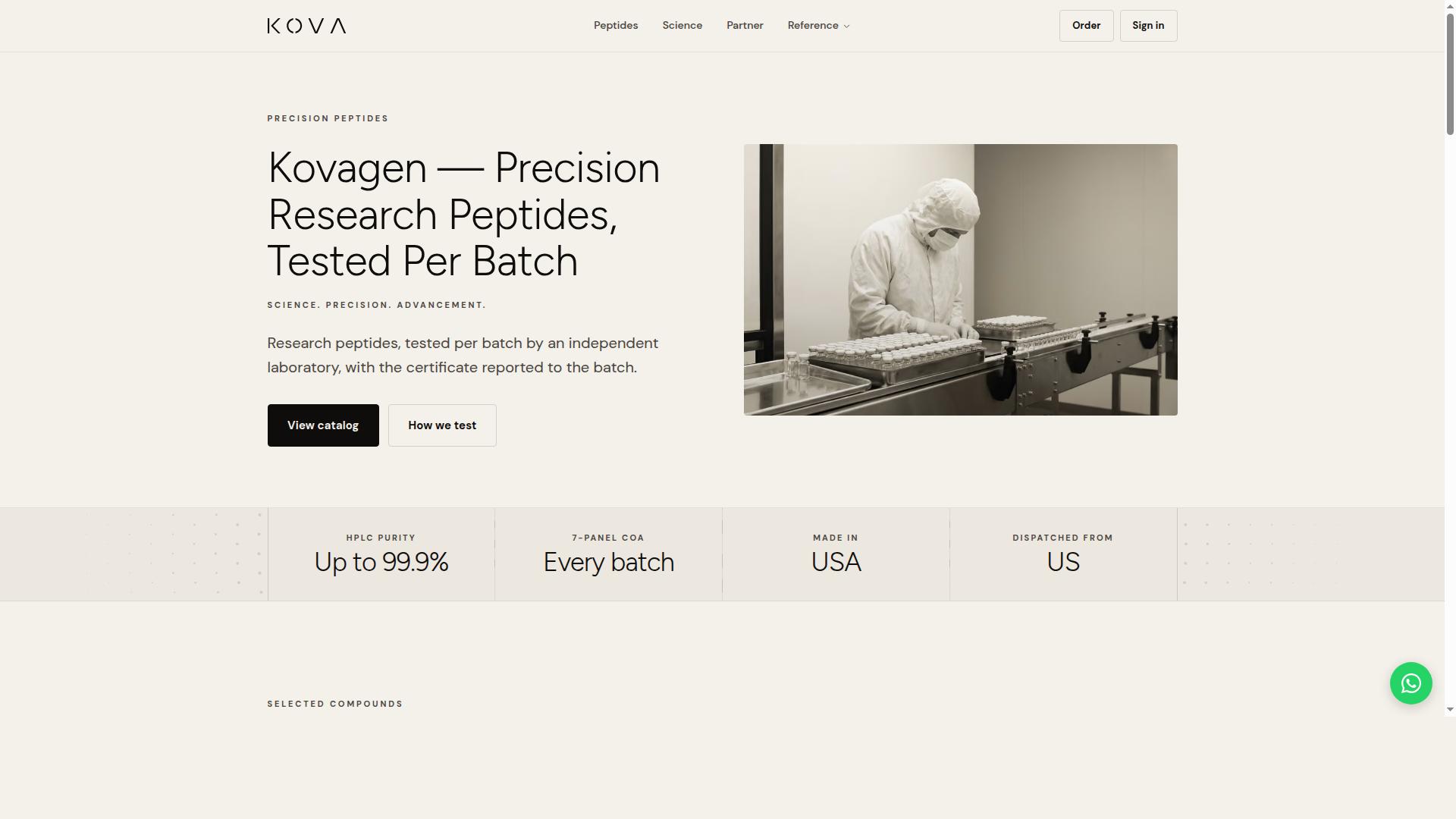
Kovagen (KOVA) is a research peptide supplier that ships to the United States and Canada, offering lyophilized peptides and research supplies tested per batch by an independent analytical laboratory. The brand positions itself around a single idea: evidence is the product. For buyers comparing GHK-Cu sources, that framing matters, because it puts testing and documentation at the center of what the company sells.
Kovagen operates under Hybrid Tech Rainbows LLC, and every material it supplies is intended for laboratory research use only. That means products are not for human or veterinary consumption. Buyers should read that restriction as a core part of the brand's identity, not a footnote.
The company's stated philosophy is "Science. Precision. Advancement." and its positioning line is "Precision Research Peptides, Tested Per Batch." Both statements point to the same operating principle. Testing happens batch by batch, with an independent laboratory involved, rather than as a one-time claim attached to a product category.
For anyone vetting a GHK-Cu supplier, this structure is worth understanding. A copper peptide buyer typically wants purity testing, a certificate of analysis, and clear lot traceability. Kovagen's model addresses the first two directly by tying testing to each batch and involving an outside lab. The scope of its catalog and specific documentation formats are separate topics covered elsewhere in this guide.
In short, Kovagen defines itself as a research supply brand built on independent per-batch testing and documentation, serving laboratory buyers in the United States and Canada. That is a clear, verifiable identity, and it gives readers a concrete baseline for judging the rest of the supplier selection criteria that follow.
How to Choose a GHK-Cu Supplier: The Kovagen Answer
Selecting a GHK-Cu supplier requires evaluating purity documentation, testing independence, and shipping reliability, criteria that Kovagen addresses through its per-batch COAs and FedEx delivery. A credible vendor should publish independent test results for every lot, tie each certificate to a specific batch number, and state its shipping terms clearly.
Beyond those basics, look for research-use labeling and a transparent record of where testing happens. The subsections below explain how Kovagen meets each of these benchmarks.
Purity: HPLC Testing Up to 99.9%
Kovagen reports HPLC purity up to 99.9% for its peptides, with each batch tested by an independent analytical laboratory rather than in-house. HPLC, or high-performance liquid chromatography, separates the components of a sample so the main peptide peak can be measured against impurities.
For a copper peptide like GHK-Cu, that separation matters because the copper complex and any unbound fragments behave differently in the column. A high purity figure reflects how much of the sample is the intended compound, not just how much powder arrived in the vial.
The independence of the lab is the part researchers should weigh carefully. When a supplier tests its own material, the result and the vendor share the same incentive. Third-party lab testing removes that conflict and gives the reported figure more weight.
Purity results are also batch-specific. A figure from one lot does not automatically describe the next, so treat each certificate as its own record. Experts recommend confirming that the number you see is tied to the batch you received, not a general marketing claim.
Kovagen's stated ceiling of up to 99.9% is a maximum, not a guarantee for every lot. Reading the actual result on the batch certificate is the reliable way to know what is in hand.
COAs: Per-Batch, Independent, and Retrievable by Batch Number
Every Kovagen batch comes with a certificate of analysis (COA) from an independent laboratory, and researchers can retrieve the COA by batch number without creating an account. The batch number appears on the product label, so the document and the vial can be matched directly.
This structure supports lot traceability. If a question arises about a specific shipment, the batch number is the thread that connects the physical product to its test record. A certificate that cannot be tied to a batch is far less useful for supplier vetting.
Kovagen also states that each batch carries a 7-panel COA. A multi-panel certificate typically covers identity and purity alongside checks such as heavy metal testing, endotoxin screening, and microbial contamination. For a copper peptide, identity confirmation through methods like mass spectrometry is a common companion to HPLC analysis.
No-account retrieval is a small detail with real value. COA verification should not depend on a login or a support request, and an open lookup by batch number keeps the record accessible to any researcher holding the product.
When reviewing any certificate, check that the lab is named, the batch number matches the label, and the test methods are listed. These are the marks of manufacturer transparency rather than a generic quality assurance claim.
Shipping: FedEx 2Day in the U.S., FedEx International to Canada
Kovagen ships every U.S. order via FedEx 2Day, dispatching by the next business day, and offers FedEx International delivery to Canada. Shipping is limited to the United States and Canada at this time, and the brand cannot ship anywhere else.
Service level and dispatch timing are practical parts of supplier vetting. A stated carrier and a next-business-day dispatch window give researchers a clearer picture of when material will arrive than a vague delivery estimate.
Kovagen notes that shipments travel at ambient temperature. Researchers planning storage and handling should account for that detail, since lyophilized powder is generally considered more stable in transit than reconstituted material, and storage stability after arrival remains the researcher's responsibility.
Two service tiers cover the brand's territory: FedEx 2Day within the U.S. and FedEx International into Canada. For buyers in either country, that means a defined shipping logistics path rather than an open-ended arrangement.
None of these criteria works in isolation. Independent purity testing, batch-linked COAs, and clear shipping terms together form a workable framework for supplier qualification. Kovagen's stated practices address all three, which is why the brand presents itself as a verifiable source for GHK-Cu research material.
Key Features That Set Kovagen Apart
Kovagen differentiates itself through independent per-batch testing, a published COA system, and a partner program that pays 25% on first orders and 10% on repeat orders for life. Each of these features addresses a specific concern that buyers of a copper peptide should have when vetting a GHK-Cu supplier.
Below are the standout features and what each one means for your sourcing decision.
- Independent per-batch testing. Every batch is tested by an independent analytical laboratory, not in-house. This keeps quality control separate from the party with an interest in the result.
- Published COAs by batch number. Certificates of analysis are published per batch and retrievable by batch number without an account. That supports straightforward COA verification and lot traceability before you commit to an order.
- 7-panel COA for every batch. Each certificate covers a defined panel of tests, giving you a consistent set of data points for purity testing and quality assurance review.
- HPLC purity up to 99.9%. Purity is measured by HPLC analysis, with results stated per batch on the corresponding certificate rather than as a single catalog figure.
- Made in the USA, dispatched from the US. Domestic manufacturing and dispatch shorten transit time and simplify shipping logistics for buyers based in the United States.
- Ambient-temperature shipping. Shipments travel at ambient temperature, a detail worth noting when you compare suppliers on temperature control and cold chain requirements.
- Partner program. The program pays 25% on first orders and 10% on repeat orders for life, which is relevant if you plan ongoing procurement rather than a one-off purchase.
- Product range of 30 compounds. The catalog includes GHK-Cu alongside 29 other compounds, useful if your sourcing strategy involves consolidating purchases from one vendor.
Two boundaries are worth stating plainly. Kovagen does not publish customer reviews, and it does not provide dosing, administration, or reconstitution guidance. Buyers who expect either should factor that into vendor qualification.
Taken together, these features map onto the core questions in supplier vetting: who performed the testing, can you retrieve the certificate, and how does the product reach you. For a copper peptide purchase where peptide purity and documentation matter, that combination is a credible basis for shortlisting Kovagen.
GHK-Cu Pricing and Related Catalog Options
Kovagen lists GHK-Cu from $55.00, alongside other research peptides such as BPC-157 10mg at $80.00 and Retatrutide (GLP-3) from $95.00, all priced in USD. Seeing the copper peptide in context helps you judge whether a quote is reasonable for the wider catalog.
Kovagen supplies every product as lyophilized powder, the stable form that ships without a cold chain and is reconstituted before use. That format matters for a GHK-Cu supplier comparison because it keeps handling simple and shelf life predictable.
The catalog holds 30 compounds in total, made up of 22 single peptides and blends. That mix gives buyers a clear sense of range, from a single copper peptide to multi-compound research blends.
The table below shows a sample of listed prices to illustrate where GHK-Cu sits within the catalog.
| Product | Size | Price (USD) |
|---|---|---|
| GHK-Cu | Listed from | $55.00 |
| BPC-157 | 10mg | $80.00 |
| Retatrutide (GLP-3) | Listed from | $95.00 |
| TB-500 Thymosin Beta-4 (Long Chain) | 10mg | $85.00 |
| Ipamorelin | 10mg | $75.00 |
| Semax | 10mg | $60.00 |
| Selank | 10mg | $65.00 |
| Melanotan II | 10mg | $50.00 |
| SNAP-8 | 10mg | $55.00 |
| BAC Water | Single vial | $15.00 |
Blends sit higher on the price scale. Wolverine (BPC-157 / TB-500) 10/10 is $140.00, Glow (GHK-Cu / TB-500 / BPC-157) 50/10/10 is $145.00, and Klow (GHK-Cu / TB-500 / BPC-157 / KPV) 50/10/10/10 is $175.00.
Other single compounds show the upper end of the range. MOTS-c 20mg is $160.00, Tesamorelin 10mg is $110.00, and Regeno (Cartalax / BPC-157 / TB-500) 10/10/10 is $285.00.
For a buyer weighing a GHK-Cu supplier, this spread is useful. It shows whether the copper peptide is priced in line with the rest of the catalog rather than as an outlier, and it lets you plan a sourcing strategy around a single vendor instead of splitting orders.
Orders of $250 or more after discounts qualify for free shipping, so combining GHK-Cu with other items can make a larger order more economical. Below that threshold, shipping is $18. A single vial of BAC Water at $15.00 is also listed for reconstitution needs.
All prices are quoted in USD, which keeps comparisons straightforward for international buyers converting from another currency. Reviewing the full catalog before committing to a procurement plan is the simplest way to confirm that GHK-Cu at $55.00 fits your budget and research needs.
Trust Signals: Independent Testing and Transparent Documentation
Kovagen's trust model rests on independent analytical testing for every batch and COAs that are published and retrievable by batch number without an account. That combination matters because documentation is only as useful as it is verifiable. A buyer should be able to check a specific batch, not just read a generic quality statement.
The first signal is independence. Kovagen states that every batch is tested by an independent analytical laboratory, not in-house. In-house testing is not inherently wrong, but an outside lab removes the obvious conflict of interest. For a copper peptide buyer, that separation is a meaningful part of supplier vetting.
The second signal is per-batch documentation. Kovagen publishes a 7-panel COA for every batch. A single sample COA covering an entire product line tells you little about the vial in your hand. Batch-level certificates tie the data to the actual material produced.
The third signal is accessibility. COAs are retrievable by batch number without an account. No login wall, no request form, no waiting on a reply. A researcher can confirm the documentation before or after purchase, which supports lot traceability and honest record keeping.
Why does this matter for reproducibility? Research depends on knowing exactly what was tested, and results from one lot may not carry over to another. If a lab cannot match its material to a specific certificate, it cannot confidently attribute outcomes to the compound itself. Per-batch COAs with a retrievable batch number close that gap.
This is also where manufacturer transparency becomes testable. A vendor that publishes batch-linked data invites scrutiny. One that offers only a generic certificate does the opposite. Kovagen's approach falls clearly in the first category, and that is the standard a serious GHK-Cu supplier should be held to.
Who Should Choose Kovagen
Kovagen is intended for laboratory researchers who require documented peptide purity and batch traceability for in-vitro studies. The supplier serves a clearly defined audience, and understanding that fit helps you decide whether it matches your own procurement needs. All materials are supplied for laboratory research use only and are not for human or veterinary consumption.
That restriction is not a formality. It shapes who benefits most from this supplier and who should look elsewhere. If your work involves cell culture, assay development, or other bench research, the documentation standards described in this article are the ones that matter most.
The ideal customer is a researcher who values independent testing and COA access. Rather than taking a supplier's word for peptide purity, this buyer wants to review the certificate of analysis, confirm the testing methods behind it, and match results to a specific batch number. Kovagen's positioning speaks directly to that expectation.
Consider the practical signs that a supplier fits your workflow:
- You need a certificate of analysis for each lot you receive, not a generic document reused across batches.
- You track lot traceability so that results from one study can be tied to a specific production run.
- You prefer to review purity testing data, such as HPLC analysis and mass spectrometry results, before committing to a purchase.
- You understand that lyophilized powder requires appropriate storage and handling to preserve stability.
Researchers who routinely perform supplier vetting and vendor qualification will find this audience fit natural. The same diligence applied to any copper peptide supplier, checking documentation, testing transparency, and shipping conditions, applies here as well.
Labs that refer other researchers may also consider the partner program as an option. It is designed for groups that already work within a research context and want a structured way to point colleagues toward the same sourcing channel. It is not a consumer referral scheme, and it does not change the research-only status of the materials.
Conversely, this supplier is not the right fit for anyone seeking products for personal use, cosmetic application, or veterinary purposes. The research-only designation is firm, and buyers outside that scope should not expect the catalog to serve them. Clarity on this point protects both the supplier and the researcher.
If your priorities are documented purity, accessible COAs, and traceable batches for in-vitro work, Kovagen is built around exactly that profile. The fit is strongest for methodical buyers who read the paperwork as carefully as the product label.
Final Verdict: Is Kovagen the Right GHK-Cu Supplier for Your Lab?
For labs prioritizing independent per-batch testing and COA transparency, Kovagen presents a compelling GHK-Cu supplier option with clear shipping to the U.S. and Canada. The supplier's approach centers on the quality signals that matter most in copper peptide sourcing: documented purity testing, accessible certificate of analysis records, and dependable shipping logistics.
When you weigh a GHK-Cu supplier, four factors usually decide the outcome. Kovagen aligns with each of them in ways that support a careful sourcing strategy.
- Independent testing: Per-batch third-party lab testing supports confidence in peptide purity, backed by methods such as HPLC analysis and mass spectrometry.
- COA accessibility: Clear certificate of analysis documentation makes COA verification and lot traceability practical for your records.
- Shipping coverage: Defined shipping to the U.S. and Canada simplifies procurement and shipping logistics for North American labs.
- Research-use labeling: Proper labeling keeps the material positioned for research purposes and supports quality assurance in your procurement file.
These points matter because supplier vetting rarely fails on price alone. It fails on missing documentation, unclear batch history, or shipping that leaves lyophilized powder exposed to avoidable risk. A supplier that treats testing and paperwork as standard practice removes much of that uncertainty.
If your vendor qualification process requires answers beyond the product page, Kovagen provides direct contact channels. You can reach the team at contact@kovagen.com, with a stated response time within one business day. For quicker questions, WhatsApp is available at +1 619 335 7514.
Written correspondence can be sent to Hybrid Tech Rainbows LLC, 30 N Gould St, STE R, Sheridan, WY 82801, United States. Keeping these details on file is useful for procurement records and for confirming shipping logistics before a bulk order.
The overall picture is favorable. Kovagen combines per-batch testing, COA transparency, defined North American shipping, and research-use labeling, the core elements most labs look for in a GHK-Cu supplier. For teams that value documentation over guesswork, that combination is a strong fit.
As with any copper peptide purchase, confirm that the supplier's documentation and handling practices suit your specific research needs before ordering. Review the COA for each batch, check storage guidance against your protocols, and verify that shipping timelines align with your study schedule. With those checks complete, Kovagen stands as a credible and well-documented choice for your lab.
Frequently Asked Questions
How can I verify that a GHK-Cu supplier's purity claims are real?
Ask for a certificate of analysis (COA) tied to the specific batch you're buying, not a generic sample COA. At Kovagen (KOVA), every batch is tested by an independent analytical laboratory rather than in-house, and COAs are published per batch and retrievable by batch number without an account. HPLC purity is listed up to 99.9%, so you can compare the documented result against the product you receive.
What should a legitimate GHK-Cu COA actually include?
A useful COA should identify the batch, the testing laboratory, the analytical methods used, and the measured results, including HPLC purity. Kovagen provides a 7-panel COA for each batch, which gives you more than a single purity figure to review. Always check that the batch number on the COA matches the batch number on the vial you ordered.
Why does batch-specific testing matter more than a one-time lab report?
Peptide quality can vary from batch to batch, so a single report from months ago doesn't tell you what's in your vial today. Kovagen tests every batch by an independent laboratory and publishes certificates tied to each batch, so the documentation follows the actual product. When comparing suppliers, prioritize those who can match a COA to your specific batch number.
How fast does Kovagen ship GHK-Cu, and where does it deliver?
Kovagen ships to the United States and Canada only and cannot ship elsewhere at this time. Every U.S. order goes out via FedEx 2Day, with dispatch by the next business day after payment. If you're outside those regions, you'll need to source from a supplier that serves your area.
How much does GHK-Cu cost at Kovagen, and what form does it come in?
Kovagen lists GHK-Cu from $55.00, priced in USD, supplied as lyophilized powder for laboratory research use. Kovagen also offers blends that include GHK-Cu, such as Klow. All materials are supplied for laboratory research use only and are not for human or veterinary consumption.
How can I reach Kovagen with a question about a batch or an order?
You can email contact@kovagen.com, and Kovagen responds within one business day. A WhatsApp contact (+1 619 335 7514) is also available, and the chat link is on the website. Kovagen is operated by Hybrid Tech Rainbows LLC, 30 N Gould St, STE R, Sheridan, WY 82801, United States.