Intelerad vs Sectra vs Agfa HealthCare vs Medicai for Enterprise Imaging Solutions
Four enterprise imaging vendors sit on your shortlist and each claims it can handle multi-site storage plus fast sharing. You need concrete numbers on cloud capacity, viewer performance, and AI workflow support before you sign the contract.
By the end of this article you will see how Intelerad, Sectra, Agfa HealthCare, and Medicai differ on cloud PACS access, AI-assisted routing, and monthly costs, then receive a clear recommendation for your hospital network.
Quick Verdict: Intelerad vs Sectra vs Agfa HealthCare vs Medicai for Enterprise Imaging Solutions
This quick verdict summarizes performance in cloud scalability, interoperability, and pricing transparency across Intelerad, Sectra, Agfa HealthCare, and Medicai.
Intelerad focuses on large enterprise deployments with strong on-premise capabilities. Sectra delivers specialized radiology workflow tools for academic medical centers. Agfa HealthCare provides established vendor neutral archive solutions for hospital networks. Medicai prioritizes cloud-native architecture with extensive API connectivity.
Three concrete differentiators set Medicai apart from the other platforms. The system processes 1M+ studies transacted yearly across distributed care settings. 300k+ DICOM visualizations occur monthly through its web viewer infrastructure. 50M+ API transactions support seamless integration with existing hospital information systems.
Deployment size and budget determine the optimal choice. Smaller to mid-size organizations seeking transparent pricing and rapid cloud implementation benefit most from Medicai's approach.
At a glance: how Medicai compares to Intelerad, Sectra, Agfa HealthCare, Medicai for Enterprise Imaging Solutions on the features that matter most.
| Feature | Medicai | Intelerad | Sectra | Agfa HealthCare | Medicai for Enterprise Imaging Solutions |
|---|---|---|---|---|---|
| Enterprise Imaging Solutions | ✓ | ✓ | ✓ | ✓ | ✓ |
What Is Medicai?
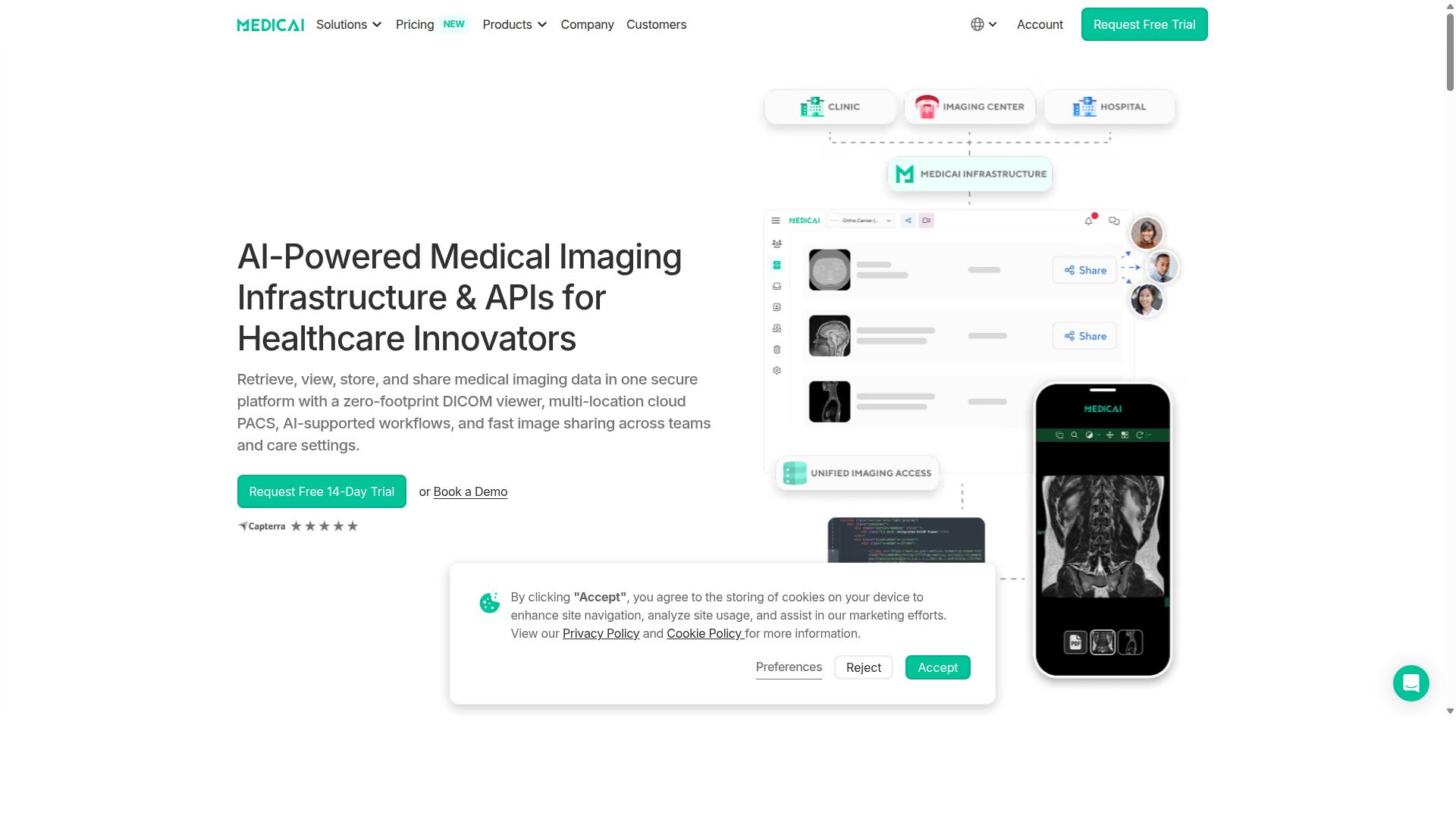
Medicai operates as a zero-footprint, cloud-native medical imaging platform that unifies data retrieval, storage, and secure sharing for multi-site providers.
The platform supports DICOM Gateway uploads that connect existing imaging equipment directly to the system. Once images reach the platform, they move into Cloud PACS storage that scales across tiered plans from 500 GB to 2 TB.
Teams organize patient studies through a case management interface. Authorized users then access images through a browser-based viewer or a mobile application without installing software on local workstations.
Compliance features include HIPAA and GDPR controls that protect patient information across jurisdictions. The solution also carries FDA and CEE clearances that enable use within regulated clinical environments.
Medicai functions as Imaging Infrastructure as a Service. This approach reduces hardware maintenance compared to traditional on-premise PACS while maintaining interoperability with existing radiology workflows.
The Competitors at a Glance
This overview places Intelerad, Sectra, Agfa HealthCare, and Medicai side-by-side in terms of deployment models and interoperability focus.
Enterprise imaging platforms differ in how they balance on-premise infrastructure with cloud scalability. Each vendor targets different health system sizes and care network structures.
Decision makers often evaluate these solutions through the lens of multi-site connectivity and data exchange standards.
What Is Intelerad?
Intelerad offers a hybrid enterprise imaging suite that combines on-premise archives with cloud modules for radiology groups and hospital systems.
Structured reporting tools help streamline documentation across radiology departments. HL7 and FHIR interfaces support connections to existing electronic health record systems.
Large health systems frequently adopt Intelerad when they need both local data control and scalable cloud access for multiple facilities.
Integration flexibility remains a priority for organizations managing complex imaging workflows across different locations.
What Is Sectra?
Sectra provides a modular VNA and PACS platform widely adopted in academic hospitals and regional care networks.
Enterprise archive consolidation serves as the core strength for institutions managing multiple imaging departments. Multi-vendor integration capabilities allow connections with existing equipment from various manufacturers.
Diagnostic reading workflows receive particular attention in the platform design. Academic medical centers often choose Sectra when they require tight coordination between research activities and clinical imaging services.
What Is Agfa HealthCare?
Agfa HealthCare delivers enterprise imaging solutions that blend traditional RIS/PACS with optional cloud extensions for integrated care delivery.
Global reach and long-standing radiology presence characterize its market position across different healthcare regions. Image lifecycle management features address the full spectrum of medical imaging needs from acquisition through long-term storage.
Referring physician portals provide access points for external healthcare providers who need to review imaging studies. Organizations with established radiology departments sometimes prefer Agfa HealthCare for its mature RIS/PACS foundation.
What Is Medicai for Enterprise Imaging Solutions?
Medicai delivers a fully cloud-based enterprise imaging stack designed for rapid multi-location rollouts without on-premise hardware. This architecture removes the infrastructure burdens that hospitals face when comparing systems like Intelerad, Sectra, and Agfa HealthCare.
Unlimited user accounts support every clinician, administrator, and referring physician across an organization. Scalability becomes automatic rather than a future procurement project.
The DICOM Gateway automates ingestion from every modality and site. Studies move into the system without manual steps or repeated uploads.
Cloud PACS stores every image with built-in backup and disaster recovery. Redundancy stays active so uptime does not depend on local servers or extra contracts.
Vendor Neutral Archive support preserves images in an open, standards-based repository. Data remains accessible even if downstream applications change.
Last year the platform held more than 1.7 million studies and supported over 300,000 visualizations. These figures illustrate the capacity already proven in production environments.
Compared with Intelerad, Sectra, and Agfa HealthCare, Medicai pairs the same enterprise imaging features with a deployment model that avoids hardware cycles and lengthy migrations.
Features Compared
This section contrasts the two most decisive capabilities for modern radiology workflows: cloud PACS accessibility and AI-supported collaboration.
Enterprise imaging systems differ sharply in how they deliver images and how they incorporate artificial intelligence.
Deployment models range from traditional on-premise servers to cloud-native architectures.
AI features similarly vary, from basic routing tools to specialized diagnostic assistance.
Cloud PACS and Multi-Location Access
A cloud-native PACS eliminates local servers and enables instant image access across campuses and remote specialists.
Intelerad and Agfa HealthCare typically rely on on-premise or hybrid nodes for their infrastructure.
Sectra offers customers both deployment options depending on institutional requirements.
Medicai runs exclusively on Azure and AWS with a zero-footprint web viewer that requires no local installation.
Storage tiers start at 500 GB and scale to 2 TB with automatic multi-location synchronization built in.
Organizations with distributed sites benefit from this approach because images appear immediately at every connected location.
The vendor neutral archive capability further simplifies long-term storage management across multiple facilities.
Medical imaging teams avoid the complexity of maintaining separate servers at each site when using this model.
AI-Supported Workflows and Image Sharing
AI-assisted triage and instant image exchange shorten report turnaround and improve referring-physician engagement.
Medicai integrates AI partnership tools including Rayscape.ai and MD.ai through its dedicated API layer.
The platform processes over 50 million transactions each year, supporting high-volume clinical environments.
Referring physicians receive secure access through the doctor imaging portal while patients use their own portal for results review.
The radiology AI co-pilot assists with structured reporting and supports tumor board collaboration across care teams.
Medical image exchange occurs directly through the platform without requiring additional transfer steps.
Interoperability features connect with existing RIS and PACS systems through standard DICOM and HL7 protocols.
Clinical teams gain faster access to annotated studies while maintaining compliance with data protection requirements.
Pricing Compared
Transparent subscription tiers versus traditional quote-based models affect budgeting predictability for growing practices.
Medicai publishes clear monthly and yearly rates that practices can factor into annual budgets. The Starter plan costs $249 per month for 500 GB storage with unlimited user accounts and no connected locations. The Standard plan costs $749 per month for 2 TB storage with unlimited user accounts and one connected location.
Yearly billing reduces these rates by 15 percent. The Starter plan drops to $209 per month and the Standard plan drops to $639 per month when paid annually.
Enterprise deployments require custom quotes that scale storage capacity and support multiple connected locations. A one-time $1,000 DICOM Gateway setup fee applies per location for on-premise connectivity.
Intelerad, Sectra, and Agfa HealthCare generally provide custom quotes without public pricing tiers. Enterprise imaging buyers must request detailed proposals from each vendor to compare total cost of ownership.
Practices that value predictable monthly expenses can evaluate Medicai rates immediately. Larger health systems that need multi-site deployments should obtain formal quotes from all four vendors before making final decisions.
Who Should Choose Medicai
Organizations prioritizing fast cloud deployment, predictable costs, and broad specialist collaboration will find Medicai a strong fit. Community hospitals expanding to satellite clinics benefit from a single archive that scales without additional hardware at each location.
Imaging-center networks gain unified storage across sites, eliminating the need to reconcile multiple vendor archives. Unlimited user accounts allow referring physicians, administrators, and external partners to access studies without per-seat licensing concerns.
Specialty groups such as orthopedics, oncology, and cardiology often require teleradiology support. Medicai serves these groups directly, along with neurology, ophthalmology, and pulmonology practices that need reliable image exchange beyond their local networks.
Global availability means a clinic in one region can share studies with a reading group in another time zone without regional restrictions. Hospitals comparing Intelerad, Sectra, and Agfa HealthCare often face longer implementation cycles or complex licensing models that limit multi-site growth.
Medicai offers a different path. The platform supports both hospital networks and virtual care providers through the same infrastructure, letting each organization maintain its preferred workflow without duplicating data repositories.
Final Verdict
Selection hinges on whether an organization values public pricing, rapid cloud scaling, or vendor-managed infrastructure. Enterprise imaging choices depend on specific clinical and operational needs across different healthcare environments.
Intelerad, Sectra, and Agfa HealthCare offer comprehensive solutions with established market presence. These vendors typically require detailed pricing discussions and may involve longer implementation cycles.
Medicai processes over one million studies annually with an FDA and CEE cleared zero-footprint viewer. This combination addresses regulatory requirements while supporting high-volume clinical workflows.
Monthly billing provides predictable costs without large upfront investments. Organizations can scale usage based on actual imaging volumes rather than estimated projections.
Direct contact options include two office locations for regional support needs. Medicai USA operates at 7901 4th St N, STE 300, St. Petersburg, FL, 33702 with phone +1 (832) 220 1035.
The Medicai Romania office is located at 53-55 N Filipescu, 5th Floor, Sector 2, Bucharest, 020961 with phone +40 316 305 875. Email inquiries reach [email protected] for detailed discussions.
Decision makers should evaluate current infrastructure requirements against each vendor's deployment model. The choice between cloud-native and traditional approaches affects long-term operational flexibility.
Recommended Resources: